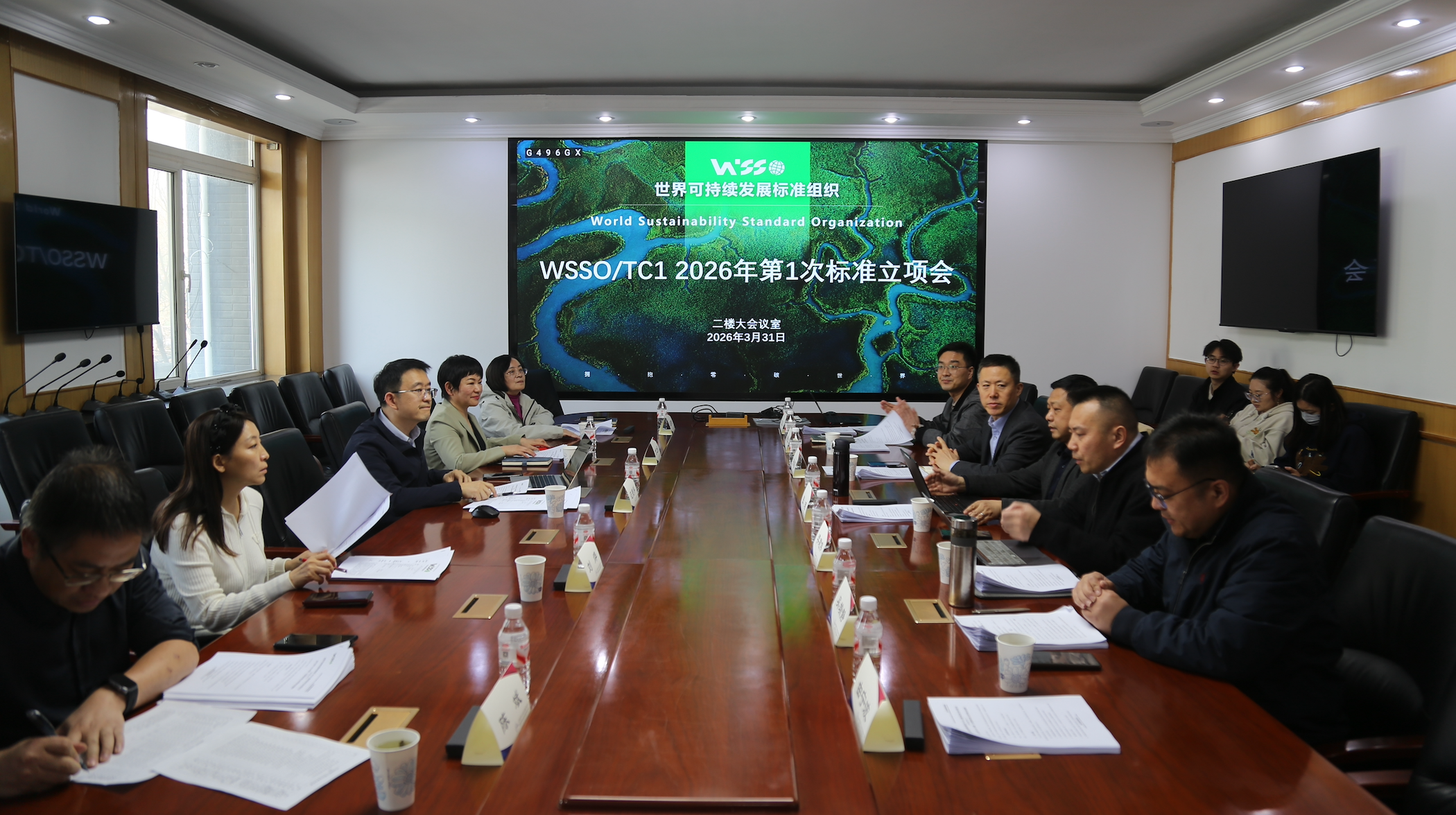
BEIJING, January 16, 2026 – The World Sustainability Standard Organization (WSSO), in close collaboration with leading industry entities and academic institutions, successfully hosted the 1st International Standard Project Review Meeting 2026 in Beijing. Centered on advancing low-carbon and circular development in the construction sector, the meeting aimed to strengthen international standardization cooperation and provide solid support for the achievement of global sustainability goals.
A panel of five senior experts specializing in urban construction and climate change was invited to participate in the review process, ensuring the scientificity and authority of the evaluation. The meeting was presided over by Li Jianwei, Deputy Secretary-General of WSSO. Representatives from the organizing institutions delivered opening remarks, elaborating on the development framework, core positioning, and standard formulation procedures of WSSO, laying a clear foundation for the smooth progress of the review work.
During the meeting, two proposed international standards were formally presented for review, covering key areas of low-carbon development in the construction industry:
• WSSO SP-2026-01: Standard for Evaluation of Low-Carbon Ready-Mixed Concrete
• WSSO SP-2026-02: Standard for Carbon Footprint Accounting of Construction Waste Recycled Aggregates
The expert panel conducted a comprehensive and rigorous evaluation of the two standards, focusing on four core dimensions: necessity of formulation, technical feasibility, innovation value, and international applicability. After in-depth discussions and detailed demonstrations, both standards were unanimously approved. This milestone marks the official launch of the standards’ development process and will provide crucial technical support for the green transformation of the global construction industry.
Key Highlights of the Standards
Low-Carbon Ready-Mixed Concrete (SP-2026-01)
This standard establishes a scientific hierarchical evaluation system covering the entire production process of ready-mixed concrete. It directly addresses the prominent issue of high carbon emissions from concrete— a material that accounts for approximately 7–8% of global carbon emissions. By filling the gap in performance benchmarks for low-carbon concrete, the standard provides clear technical guidance for green procurement, carbon finance practices, and international trade, enabling enterprises to better comply with global low-carbon requirements.
Recycled Aggregate Carbon Footprint (SP-2026-02)
Focusing on the carbon accounting of construction waste recycled aggregates, this standard develops a quantitative carbon footprint calculation model. It adopts internationally aligned data collection rules and quality control standards, and introduces both “cradle-to-gate” and “cradle-to-grave” accounting approaches. This design not only ensures the accuracy and comparability of carbon data but also facilitates the mutual recognition of carbon footprint results and promotes the development of the circular economy in the construction sector.
Next Steps
Moving forward, WSSO will join hands with the initiating organizations to establish a professional drafting working group, actively expand the participation of international institutions, and advance the research, framework design, and technical validation of the two standards. Meanwhile, WSSO will strengthen international coordination and conduct extensive public consultations to ensure that the final standards are scientifically rigorous, practically operable, and globally applicable.
The meeting attracted representatives from well-known enterprises and universities in the construction field, fully reflecting the strong synergy between industry and academia in promoting sustainable development. This collaboration will further accelerate the popularization and application of low-carbon standards, driving the construction industry towards greener, more efficient, and sustainable development.